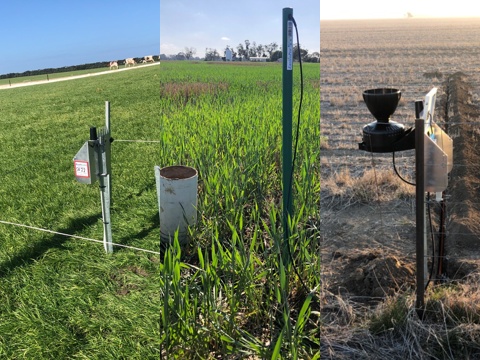
The right sensor for the job
Different crops and different decisions need different sensors, so we offer options rather than one probe for everything.
- Cropping probes — capacitance probes (120cm, 12 sensors recommended) for rooting depth, crop water use, nitrogen decisions and water available for grain fill.
- Irrigation probes — capacitance probes (80cm, 8 sensors recommended) for scheduling: see what depth needs refilling, control drainage and make the most of rainfall.
- Matric potential sensors — a direct measure of plant water stress (kPa) for stress-sensitive crops, usually at three depths.
- EnviroPro soil probes — multi-depth capacitance probes from 40cm to 160cm, measuring moisture and temperature, with salinity (EC) as an option.
What the data gives you
- Soil moisture sum and split sums through the profile
- Stacked sensor charts showing how deep water gets
- Daily water use and a soil moisture "bucket"
- Years of history to compare seasons
- Sharing with your agronomist — you control who sees it
Trials and networks
Soil probes are also used at research trial sites to compare water use and infiltration between treatments, and in regional soil moisture networks. See our projects.
Install quality decides data quality
A probe reads the soil it's touching. A hole that's slightly too wide, a smeared wall in clay, or an air gap at one depth will read dry all season no matter what the sky does — and nobody can tell from the graph that the install was the problem. That's why these go in properly, with the right gear, rather than being posted out to be dropped in a post hole.
Permanent sites are installed with machinery access in mind: where the boom will swing, where the harvester turns, what happens at seeding. A site that gets clipped once tends to get clipped again.
The first season is the baseline
One season tells you how your soil fills and empties. Several tell you what's normal for that paddock — how deep the break really got, what the profile looked like the year the crop finished well, how much water was left at grain fill. The data compounds, which is why history is carried across hardware upgrades rather than started again.
Trials and networks
The same probes go into research trial sites to compare water use and infiltration between treatments, and into regional soil moisture networks where the readings are shared publicly. See projects.
Getting one
Direct from us in South Australia and Victoria, or through a distributor. Ask about funding — soil moisture sites have been covered by rebate rounds before.
Want the full detail?
This is a quick overview. Specs, photos, how it works and real-world examples are on the Soil Moisture Monitoring page of the BushLinx® website.
View on bushlinx.com.au ↗