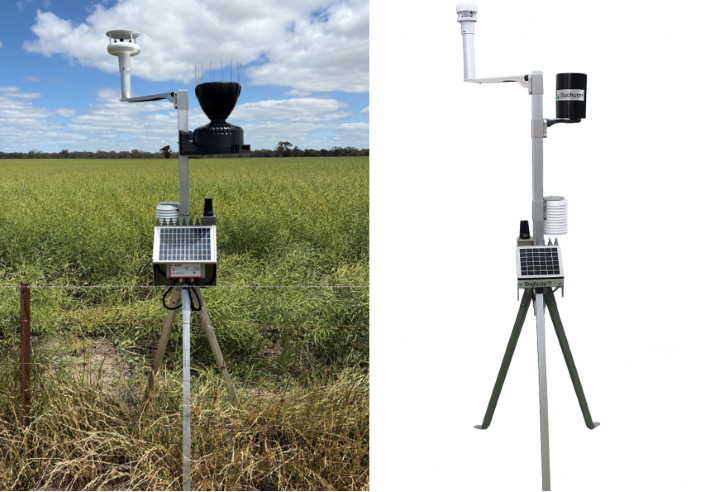
Your own local climate record
Weather data sits behind almost every on-farm decision — irrigation scheduling, spray windows, frost risk, harvest planning. BushLinx® weather stations log continuously and stream to the BushLinx® platform in real time, where the readings are graphed, calculated, forecast and archived.
On-farm forecasts, through our partnership with Janes Weather, turn what's happening now into a tool for planning what's next — tomorrow's spray window, or how many harvest hours you'll get before the fire danger climbs.
Two configurations
- Advanced — the go-to for cropping, with a sensor set good enough to feed a hyperlocal forecast. Leaf wetness and VTD (temperature inversion) sensors can be added.
- Standard — a general-purpose sensor set for environmental monitoring and stock enterprises.
What it gives you
- Rainfall, temperature, humidity, wind, solar radiation and ETo
- Spraying — Delta-T, wind speed and wet bulb
- Harvesting — Harvest Fire Danger Index and Fire Behaviour Index
- Livestock — cattle heat load and sheep fly strike index
- Frost severity, heat and chill hours, degree days and growing season rainfall
- On-farm and hyperlocal forecasts
On farms, in groups, in public networks
A station can stay private, be shared into a group network, or feed a public regional network. See how that works in farming groups and public networks.
Where it goes changes what it tells you
A station beside a shed or under a tree line reports the shed and the trees. Wind slows, heat radiates off iron, and the rain gauge catches what the roof throws at it. Siting is the first thing we work through — open ground, sensible height, clear of obstructions — then power, mobile coverage, and whether a radio link back to a base makes more sense than 4G at that spot.
We commission on site and watch the first readings come through before leaving. Alert thresholds, dashboards, data displays and sharing are all managed in software and updated to suit what you need to see - the way you need to see it.
One station or a district
The same hardware and platform runs a single farm station and a regional network, which is why a grower group's stations, a corporate's properties and a catchment authority's public network can share one map. That's the work described in projects.
Getting one
Direct from us across South Australia and Victoria, or through a distributor elsewhere. Weather stations have been eligible under government rebate rounds before — funding covers what's open now.
Want the full detail?
This is a quick overview. Specs, photos, how it works and real-world examples are on the Weather Stations page of the BushLinx® website.
View on bushlinx.com.au ↗